

In short: Prolapsed hemorrhoids are enlarged vascular cushions that protrude from the anal canal. Rectal prolapse occurs when part or all of the rectal wall slips downward and may extend through the anus. Both can cause bleeding, mucus and a visible bulge, so appearance alone is unreliable; examination is needed because the treatment pathways differ.
Key takeaways
- Both conditions may protrude during straining and reduce afterward.
- Rectal prolapse often forms a broader circular or sleeve-like protrusion; hemorrhoids more often appear as separate cushions.
- Mucus leakage, incomplete emptying and faecal incontinence can accompany rectal prolapse.
- A trapped, dark or very painful prolapse needs urgent assessment.
- Constipation and straining should be addressed, but exercises or creams cannot correct every form of prolapse.
What each condition involves
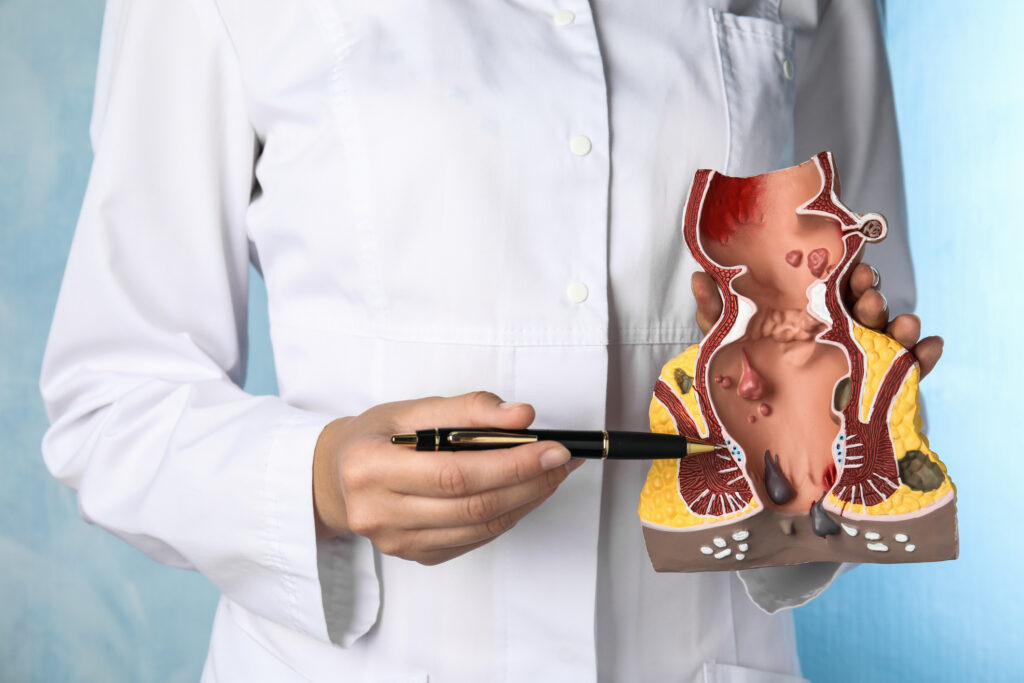
Internal hemorrhoids are normal vascular cushions that become enlarged or symptomatic. When they descend through the anal opening, they are described as prolapsed. Their severity is often graded by whether they reduce on their own or need manual reduction.
Rectal prolapse involves the rectum losing support and sliding downward. It may be internal, remain within the body or extend through the anus. Mucosal prolapse involves only the inner lining, while full-thickness prolapse includes the full rectal wall.
How the symptom patterns compare
| Feature | Prolapsed hemorrhoids | Rectal prolapse |
|---|---|---|
| Tissue pattern | Often separate bulges or cushions | Often a broader circular or sleeve-like protrusion |
| Bleeding | Bright-red bleeding can occur | Bleeding or mucus may occur from exposed tissue |
| Pain | May be painless unless thrombosed or trapped | Often pressure or discomfort; severe pain suggests incarceration or another problem |
| Bowel function | Itching, soiling or incomplete cleaning may occur | Constipation, incomplete emptying or faecal incontinence may occur |
| Treatment focus | Bowel habits, office procedures or hemorrhoid surgery | Pelvic-floor and bowel assessment, often followed by prolapse repair |
Why self-diagnosis is difficult
A prolapsed hemorrhoid, rectal mucosal prolapse and full-thickness rectal prolapse can look similar to a non-specialist. Swelling, skin tags and other lesions may add further confusion.
Photographs found online are not diagnostic. The clinician may ask the patient to strain in a safe setting if the prolapse is not visible at rest. A description of size, colour, pattern and whether it reduces can still help.
What the assessment may include
The history covers constipation, straining, diarrhoea, childbirth, pelvic surgery, bowel control, urinary symptoms and how long the protrusion remains outside. Examination may include inspection, digital rectal examination, anoscopy or proctoscopy.
Selected patients may need colonoscopy, pelvic-floor testing, defecography or transit studies. Tests are chosen to answer questions about other bowel disease, pelvic-floor function and the operation most likely to help.
Treatment pathways are different
Mild hemorrhoid symptoms may improve with stool-softening measures and changes in toilet habits. Persistent prolapse may be treated with an office procedure or surgery, depending on anatomy and symptoms.
Full-thickness rectal prolapse is usually corrected surgically when symptoms justify treatment. Operations may be performed through the abdomen or perineum, with the approach based on health, bowel function, previous operations and prolapse characteristics. No article can select the operation for an individual.
When to seek urgent care
Seek urgent assessment if protruding tissue cannot be reduced, becomes dark or dusky, causes severe increasing pain or is accompanied by heavy bleeding, fever, vomiting or abdominal swelling. Reduced blood supply to trapped rectal tissue is an emergency.
A non-painful prolapse still deserves a planned evaluation because repeated exposure can worsen irritation, leakage and functional problems.
Care at German Medical Center
German Medical Center lists General Surgery and Proctology assessment for anorectal disorders and has a dedicated hemorrhoid treatment page.
You can also review General Surgery and Proctology Department, Hemorrhoids Treatment service and Hemorrhoids versus anal fissure article for relevant service and related-care information.
To discuss your symptoms or test results, Contact German Medical Center to request an appointment with the relevant department in Dubai Healthcare City. The clinician will determine whether further testing or treatment is appropriate for you.
Frequently asked questions
Can hemorrhoids turn into rectal prolapse?
No. They are different anatomical conditions, although chronic straining can contribute to both and they may coexist.
Can rectal prolapse go back in on its own?
Early or intermittent prolapse may reduce after a bowel movement or when lying down. This does not mean the supporting problem has resolved, and repeated episodes should be assessed.
Is rectal prolapse always painful?
No. It may cause pressure, mucus, leakage or incomplete emptying without severe pain. Sudden severe pain or trapped discoloured tissue needs urgent medical attention.
Will pelvic-floor exercises fix rectal prolapse?
Pelvic-floor therapy may help selected functional symptoms, but it does not reliably correct established full-thickness external prolapse. A specialist should define the type of prolapse first.
Will I need surgery?
Not every protruding lump needs surgery. Hemorrhoid treatment ranges from conservative care to office procedures and surgery. Symptomatic full-thickness rectal prolapse more often requires operative repair, tailored to the patient.
Medical disclaimer
This article provides general health information and does not replace an individual consultation, diagnosis or treatment plan. Symptoms can have several causes. Seek urgent medical care for severe, sudden or rapidly worsening symptoms.