


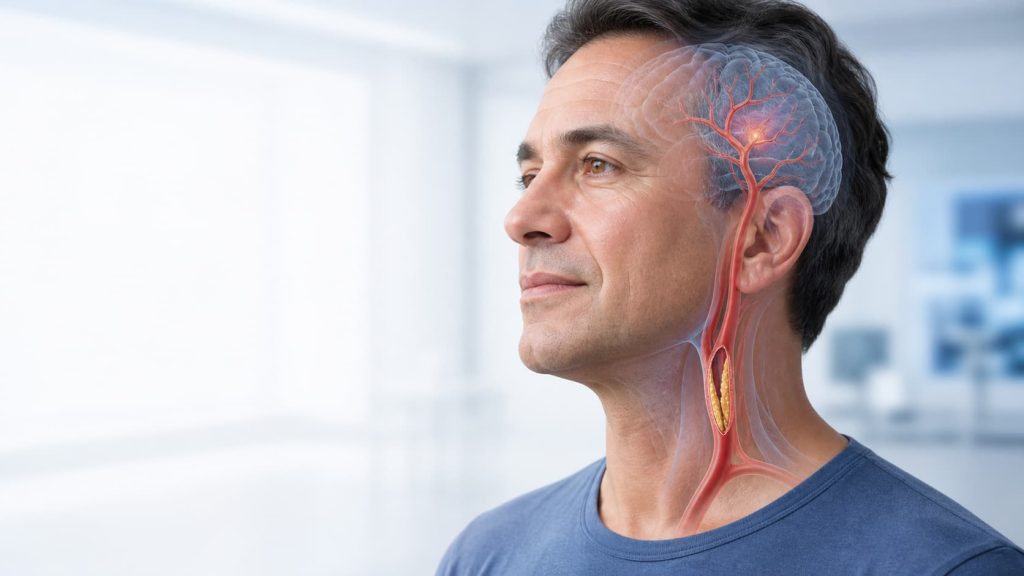
Carotid artery stenosis often develops quietly. A person may feel well while fatty plaque gradually narrows one or both carotid arteries—the major blood vessels running along the sides of the neck and supplying the brain. Sometimes the first obvious clue is a transient ischaemic attack (TIA) or stroke.
That sounds alarming, but it is also a reason to be practical. Knowing the warning signs, understanding your personal stroke risk and seeking the right medical assessment can make a real difference. Here is what carotid artery stenosis means, when a carotid artery ultrasound may be useful and why routine screening is not recommended for everyone.
What is carotid artery stenosis?
Carotid artery stenosis is the narrowing of a carotid artery, usually because of atherosclerosis. This is a gradual build-up of plaque made from cholesterol, fat, calcium and other substances found in the blood.
The narrowing can affect the brain in two ways. It may reduce blood flow, or part of the plaque may break away and travel upward, blocking a smaller artery in the brain. Either event can cause a TIA or an ischaemic stroke.
Carotid disease is part of a wider vascular picture. Someone with plaque in the neck arteries may also have disease affecting the heart, legs or other blood vessels. That is why assessment is not only about measuring one narrowing; it also involves controlling the health factors driving the disease.
Warning signs that need immediate attention
Many people with carotid artery stenosis have no early symptoms. When symptoms do occur, they are often those of a TIA or stroke and usually begin suddenly.
The CDC recommends BE FAST as a quick way to remember possible stroke symptoms:
- Balance: Sudden dizziness, unsteadiness or loss of coordination
- Eyes: Sudden blurred vision, loss of vision or double vision
- Face: One side of the face droops or feels numb
- Arms: Sudden weakness or numbness, especially on one side
- Speech: Slurred speech, unusual words or difficulty understanding
- Time: Call emergency services immediately
Other warning signs include sudden weakness in a leg, confusion or a severe headache with no known cause. A brief episode of blindness in one eye, sometimes described as a curtain coming down, also needs urgent assessment.
Do not wait to see whether the symptoms settle, and do not drive yourself to hospital. Note the time they started and call emergency services. Even if everything returns to normal within minutes, the event may have been a TIA. A TIA is a warning, not a harmless “mini-stroke,” and the risk of a full stroke can be highest soon afterwards.
How carotid narrowing increases stroke risk
The percentage of narrowing matters, but it is not the whole story. Stroke risk is also influenced by whether symptoms have occurred recently, what the plaque looks like, how quickly the narrowing is changing, the condition of the opposite carotid artery and a person’s overall health.
Symptomatic carotid artery stenosis generally demands more urgent investigation than an incidental narrowing in someone who has never experienced neurological symptoms. This is why two people with a similar ultrasound result may receive different recommendations. A specialist weighs the scan findings against age, medical history, anatomy, medicines and the likely benefit and risk of a procedure.
Who is more likely to develop carotid artery disease?
The chance of carotid plaque rises with age. Important stroke risk factors include:
- Smoking or previous long-term tobacco use
- High blood pressure
- High LDL cholesterol
- Diabetes
- Heart disease or peripheral artery disease
- A family or personal history of atherosclerotic disease
- Limited physical activity and excess weight
Having one or more of these factors does not prove that a carotid artery is narrowed. It does mean that a conversation about cardiovascular prevention is worthwhile. Blood pressure, cholesterol, glucose control, smoking cessation, movement and nutrition affect far more than the arteries in the neck.
When is carotid artery stenosis screening needed?
This is where wording matters. “Screening” means testing people who have no symptoms or previous TIA or stroke. “Diagnostic testing” means investigating a symptom, examination finding or known medical problem.
Routine screening of the general adult population with carotid ultrasound is not recommended. The US Preventive Services Task Force concluded that, in adults without relevant neurological symptoms, the potential harms of screening outweigh the benefits. Although ultrasound is safe, widespread testing can find changes that would never cause a stroke, create false-positive results and lead to further scans or procedures that carry risk.
A doctor may still consider carotid artery ultrasound in selected situations, such as:
- After a TIA, stroke-like episode or temporary loss of vision
- When an examination identifies a carotid bruit, depending on the wider clinical picture
- For someone with known peripheral artery disease or other significant cardiovascular disease
- When several vascular risk factors are present and the result could change care
- To monitor carotid disease that has already been diagnosed
- Before certain major operations, when the treating team believes testing is relevant
There is no single age at which everyone should book a carotid scan. The sensible starting point is an individual assessment, not a self-selected screening package. A clinician can decide whether an ultrasound is likely to answer a meaningful question.
What happens during diagnosis?
A carotid duplex ultrasound is usually the first test. It is non-invasive, uses no radiation and combines standard ultrasound images with Doppler measurements of blood flow. The scan helps estimate where the artery is narrowed and how severe the narrowing may be.
If more anatomical detail is needed, the doctor may arrange CT angiography or MR angiography. Results should be interpreted alongside symptoms and a physical examination. A scan percentage on its own is not a treatment plan.
At German Medical Center, patients with suspected or confirmed disease can be assessed through Vascular Surgery. People who need broader management of blood pressure, cholesterol or cardiovascular risk can also be directed to Internal Medicine or Endocrinology, particularly when diabetes is part of the picture.
How is carotid artery stenosis treated?
Treatment is personalised. For many people, the foundation is best medical therapy: stopping smoking, being physically active, improving diet, controlling blood pressure and diabetes, and taking prescribed cholesterol-lowering or antiplatelet medication when clinically appropriate. Do not start aspirin or change an existing medicine without medical advice; the benefit and bleeding risk differ from person to person.
Some patients may benefit from a procedure to restore safer blood flow. Carotid endarterectomy removes plaque through an operation on the neck. Carotid artery stenting uses a catheter and stent to widen the artery. The choice depends on whether symptoms have occurred, the degree and location of narrowing, age, anatomy, other illnesses and the expertise of the treating team.
A consultation with a vascular surgeon in Dubai does not automatically lead to surgery. Its purpose is to define the risk accurately, discuss medical and procedural options, and build a follow-up plan around the individual rather than the scan alone.
When should you book an appointment?
Book a non-emergency appointment if you have multiple vascular risk factors, have been told you have a carotid bruit, already have peripheral artery or coronary artery disease, or need follow-up for a previous carotid scan. German Medical Center’s preventive health packages may support broader risk assessment, while a clinician should determine whether carotid imaging itself is appropriate.
If you have experienced any sudden neurological symptom—even one that has resolved—seek urgent emergency assessment rather than waiting for a clinic booking. The centre’s Stroke Treatment information can help patients understand related care, but it is not a substitute for emergency services when symptoms are happening.
The key message
Carotid artery stenosis can be silent, yet indiscriminate screening is not the answer. The safer approach is to recognise stroke warning signs, act immediately when they appear and assess screening needs in the context of your health history. If you are concerned about carotid disease or your stroke risk, request an appointment with German Medical Center for a personalised evaluation.