


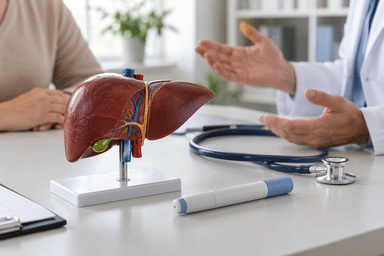
Some medicines used for weight management can improve important measures of fatty liver disease, but “reverse fatty liver” is too broad to describe what has been proven. The strongest answer depends on the exact drug, the type and stage of liver disease, and the outcome being measured. Semaglutide has shown benefits in a major trial involving people with MASH and significant fibrosis. That does not mean every weight-loss injection cures every form of fatty liver or that treatment can begin without assessment.
For patients in Dubai, another distinction matters: evidence from an international trial and approval by the United States Food and Drug Administration do not establish the medicine’s authorised indication in the UAE. The local prescribing position must be checked separately.
First, clarify what “fatty liver” means
Fat in the liver is a finding, not a complete description of disease severity. Metabolic dysfunction-associated steatotic liver disease, or MASLD, is the newer terminology commonly used for metabolic fatty liver disease. MASH refers to the inflammatory form, previously called NASH. Fibrosis means scar tissue, and advanced scarring can progress to cirrhosis. These terms describe different aspects of the condition rather than interchangeable labels. FDA: MASH and treatment approval.
If an ultrasound report says “fatty infiltration,” ask what additional information is needed to assess your risk. The report may identify fat without answering whether significant inflammation or scarring is present. A medication discussion should therefore begin with the diagnosis and stage, rather than with a preferred brand.
It is also useful to distinguish the liver problem from associated health goals. Improving blood sugar, managing weight and assessing cardiovascular risk may all matter, but they are not the same outcome as improving liver fibrosis. A clear treatment plan states which goals apply to you and how each will be monitored.
Why the word “reverse” needs careful interpretation
A headline may use “reversal” to mean less fat on a scan, improved liver enzymes, resolution of inflammatory disease on biopsy or a reduction in fibrosis stage. Those outcomes are related, but they are not equivalent. A result should be described in the terms actually measured.
For example, an improved blood test can be encouraging without proving that all scar tissue has disappeared. Similarly, a study showing improvement after a defined treatment period does not automatically establish a permanent cure after treatment stops. Ask what evidence supports the exact claim being made.
This is not a reason to dismiss encouraging results. It is a way to make them useful. A realistic discussion might say, “This treatment has evidence for improving these outcomes in people with this stage of disease,” followed by an explanation of how closely your circumstances match that group.
Before making a decision, translate a claim into three questions: who was studied, what changed and over what period? If those details are missing, the word “reverse” is doing more work than the evidence allows.
What the semaglutide trial actually found
The phase 3 ESSENCE trial studied semaglutide in people with biopsy-confirmed MASH and stage F2 or F3 fibrosis. In its reported interim analysis of 800 participants at 72 weeks, MASH resolution without worsening fibrosis occurred in 62.9% of the semaglutide group and 34.3% of the placebo group. Improvement of at least one fibrosis stage without worsening MASH occurred in 36.8% and 22.4%, respectively. The study was funded by Novo Nordisk. ESSENCE trial, New England Journal of Medicine, 2025.
These results support a meaningful treatment benefit in the studied population. They do not mean that every participant improved, that cirrhosis was cured or that the same percentages apply to someone with an ultrasound finding alone. The reported analysis also does not settle every question about long-term clinical outcomes.
When discussing this study, ask whether your diagnosis resembles the trial population and which outcome is relevant to your care. A percentage from a study is a group result, not an individual guarantee. Your clinician should explain both the potential benefit and the remaining uncertainty.
What the US approval does and does not tell you
The FDA approved Wegovy injection for adults with noncirrhotic MASH and moderate-to-advanced fibrosis under an accelerated approval pathway. The indication is specific; it is not a statement that all semaglutide products, all doses or all medicines marketed for weight management are interchangeable treatments for liver disease. FDA approval information.
For someone receiving care in the UAE, ask the prescriber to confirm the current local authorisation, the proposed indication and the exact product. If a treatment is being discussed outside a locally authorised indication, that needs an explicit explanation of the rationale, evidence and consent process.
Insurance coverage is another separate question. A medicine can be clinically appropriate yet subject to coverage criteria, documentation requirements or exclusions. Obtain clear information before committing to a plan that may be difficult to sustain.
Avoid relying on social media screenshots of overseas approvals. The relevant decision is whether the specific treatment is appropriate, lawful and available for your situation through a qualified local clinician.
The assessment before any prescription
Liver assessment may include medical history, alcohol intake, medicines, blood tests and imaging. Clinicians can use blood-based calculations and tests such as elastography to assess the likelihood of fibrosis; biopsy is reserved for selected circumstances. The choice depends on what remains uncertain and what information would change management. NIDDK: diagnosis of fatty liver disease.
Bring earlier liver results and reports, including the dates. A timeline can show whether the finding is new, stable or previously investigated. Include any supplements, herbal products and medicines you use, even if you do not think of them as relevant to the liver.
Be candid about alcohol. The purpose is to understand possible contributors and choose appropriate care, not to assign blame. If you are unsure how much a usual drink contains, describe the beverage and serving size rather than guessing a number.
Ask the clinician to summarise the current working diagnosis before moving to treatment. You should understand whether the main question is the presence of fat, the likelihood of significant fibrosis, another cause of liver disease or several issues together.
Is a weight-management medicine the right option for everyone?
No single medicine is the automatic next step for every person with fatty liver. The decision needs to account for the liver assessment, the reason for prescribing, other conditions, current medicines and your ability to follow the plan. A familiar brand name should not replace this review.
It is reasonable to ask what alternatives are available and why the proposed option is preferred. That discussion may include structured lifestyle support, management of associated metabolic conditions, specialist liver review or a medicine with a specific indication. The appropriate combination is individual.
If your main goal is liver health rather than weight change, say so clearly. This helps the clinician explain whether the proposed treatment is intended primarily for weight management, diabetes, a liver indication or more than one purpose.
Do not assume that evidence for one drug applies to every injection in the same broad market. Ask for the evidence supporting the exact agent and outcome being discussed, particularly when a clinic uses broad phrases such as “liver detox” or “complete reversal.”
Side effects and safety belong in the decision
A prescription discussion should cover common side effects, important precautions, interactions and what to do if problems occur. Semaglutide product information includes gastrointestinal effects and warnings involving issues such as pancreatitis, gallbladder disease and dehydration-related kidney problems. Personal or family history of medullary thyroid carcinoma and MEN2 are relevant contraindication questions in the US label. Pregnancy plans also require discussion. These are examples, not a complete safety checklist. Wegovy prescribing information.
Ask which instructions apply to the product prescribed locally. Confirm whom to contact if you cannot tolerate treatment, miss a dose or develop new symptoms. Do not improvise dose changes or borrow another person’s medicine.
A good plan also considers practical use. You should understand the storage instructions, the administration method and how follow-up will work. If anything is unclear, ask for a demonstration or written guidance from the prescribing team or pharmacist.
Lifestyle care remains part of liver care
Weight management, physical activity and dietary changes remain important components of metabolic fatty liver care. The approach should be appropriate to your health and sustainable over time; rapid or extreme self-directed weight-loss attempts are not a substitute for a clinical plan. NIDDK: treatment of fatty liver disease.
Instead of treating lifestyle advice as a vague instruction to “be healthier,” ask for a plan that fits your routine. Discuss working hours, food access, cultural preferences, travel and any pain or disability that affects activity. The most useful recommendation is one you can put into practice and review.
If medication changes appetite, ask how nutritional adequacy will be supported. The goal is not merely a lower number on the scale. Your care plan should remain attentive to strength, day-to-day function and the ability to maintain helpful habits.
Avoid framing treatment as a test of willpower. If a plan is difficult to follow, identify the obstacle with the care team. Adjusting an unrealistic plan is more useful than repeatedly restarting it without understanding why it failed.
Decide in advance how progress will be measured
Before treatment starts, ask the clinician to record the baseline findings and the intended outcomes. Which blood tests, weight-related measures or liver assessments will be reviewed? When will they be repeated? What would count as a meaningful response, and what would prompt a change?
This prevents the plan from being judged only by appearance or a single laboratory value. It also helps you understand why a particular test is being repeated and why another may not be needed yet.
Ask what happens if weight changes but the liver assessment remains concerning, or if side effects limit treatment. A plan should include a response to incomplete benefit, not only an expectation of success.
Keep copies of results and a simple medication timeline. If you receive care from more than one specialist, share the same current information with each. This reduces the chance of decisions being based on an outdated medicine list or an isolated result.
Think about the whole treatment period
An injection is not just a purchase for the first month. Discuss the likely follow-up schedule, cost, access and the circumstances in which treatment would be reviewed or stopped. Ask what monitoring would continue if the medicine changes or ends.
This is particularly relevant if your work involves frequent travel or you may move between countries. Local availability and prescribing rules can differ. Planning ahead is preferable to interrupting care unexpectedly and then trying to reconstruct the treatment history elsewhere.
Ask for a written summary of the indication, product, monitoring plan and contact arrangements. Keep it with your other medical records. A clear summary makes future conversations with clinicians and insurers easier and helps you distinguish medical advice from promotional claims.
Separate a clinical result from a marketing photograph
Before-and-after photographs cannot show the degree of liver inflammation or fibrosis. They may illustrate a change in appearance, but they do not establish the outcome that matters for a liver-treatment claim. Ask for the clinical measure behind the claim and whether it applies to the exact treatment being offered.
The same caution applies to testimonials. A person’s positive experience may be sincere while providing too little information to guide your own decision. You do not know their original diagnosis, other treatments or follow-up findings from a short quotation.
Use promotional material as a prompt for questions rather than as the basis for prescribing. A credible consultation should be able to explain the evidence, its limits and the monitoring plan without relying on a dramatic image or a promise of complete reversal.
Common questions about injections and fatty liver
Can a normal liver enzyme result prove that my liver is fully healthy? It should be interpreted within the wider assessment. Ask whether fibrosis risk has been addressed and whether further evaluation is appropriate in your circumstances. Do not use one result as a substitute for the agreed follow-up plan.
Can I start an injection because my ultrasound says fatty liver? The report is a reason to discuss liver health, not enough information on its own to select a medicine. The clinician needs to establish the treatment indication and assess your overall situation.
Are all weight-loss injections equivalent for liver disease? No. Evidence and authorisations are specific to the medicine, formulation, population and outcome. Ask about the exact treatment proposed rather than assuming a class-wide effect.
Does improvement mean I can stop follow-up? Not automatically. Confirm what monitoring remains necessary and who will coordinate it. A favourable change is useful information, but it does not replace an individual long-term plan.
Should I wait for medication before changing my routine? Discuss achievable steps with your clinician now. A medication decision and practical support for everyday habits can be developed together rather than treated as competing approaches.
Discuss your liver assessment at German Medical Center
GMC lists gastroenterology and endocrinology services. Contact the clinic to arrange an appropriate assessment and bring your liver reports, medication list and previous results. Ask the clinician to clarify the diagnosis, fibrosis assessment and locally appropriate treatment options before choosing a medicine.
GMC offers liver elastography (FibroScan-type liver stiffness testing) and care for cirrhosis. Related reading: fatty liver and liver elastography, fatty liver disease causes and risk factors and metabolic syndrome in the UAE.
This article provides general information, not a prescription. Drug indications and availability require current local verification by the treating clinician.