

Prediabetes often arrives as a number on a laboratory report. You may feel perfectly well, yet your HbA1c or fasting glucose suggests that your body is not handling sugar as efficiently as it once did. The usual advice—eat better, move more and lose weight if needed—is sensible. It can also feel frustratingly broad.
This is why continuous glucose monitoring for prediabetes has attracted so much interest. Instead of seeing one reading from a blood test, you see a moving picture of your glucose across the day and night. Breakfast, an evening walk, a poor night’s sleep: each can leave a visible trace.
That information can be eye-opening, but more data is not always better data. A CGM is a tool, not a verdict. Whether it is worth using depends on what you hope to learn, how the results will be interpreted and whether those insights lead to changes you can maintain.
What is prediabetes?
Prediabetes means blood glucose is higher than the usual range but does not meet the criteria for diabetes. One commonly used marker is HbA1c, which reflects average glucose over roughly two to three months. An HbA1c of 5.7% to 6.4% falls within the prediabetes range. A fasting plasma glucose of 100–125 mg/dL, or a two-hour oral glucose tolerance result of 140–199 mg/dL, can also indicate prediabetes.
These results are a prompt to look more closely at food, activity, sleep, weight, family history and other health factors. Prediabetes management works best when it fits real life.
Importantly, a CGM cannot diagnose prediabetes. Current American Diabetes Association guidance says there is insufficient evidence to use CGM for screening or diagnosis. Diagnosis should be based on recognised laboratory tests and interpreted by a healthcare professional.
How does a continuous glucose monitor work?
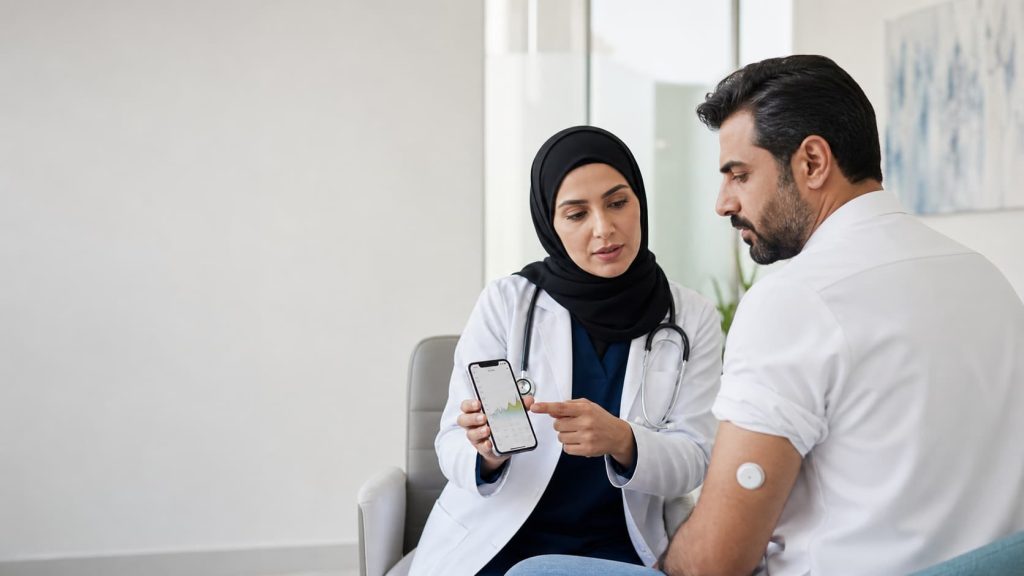
A CGM uses a small sensor, usually worn on the upper arm or abdomen, to estimate glucose in the fluid between cells. It records readings repeatedly and sends them to a phone, reader or app. Depending on the device, a sensor may be worn for several days or longer.
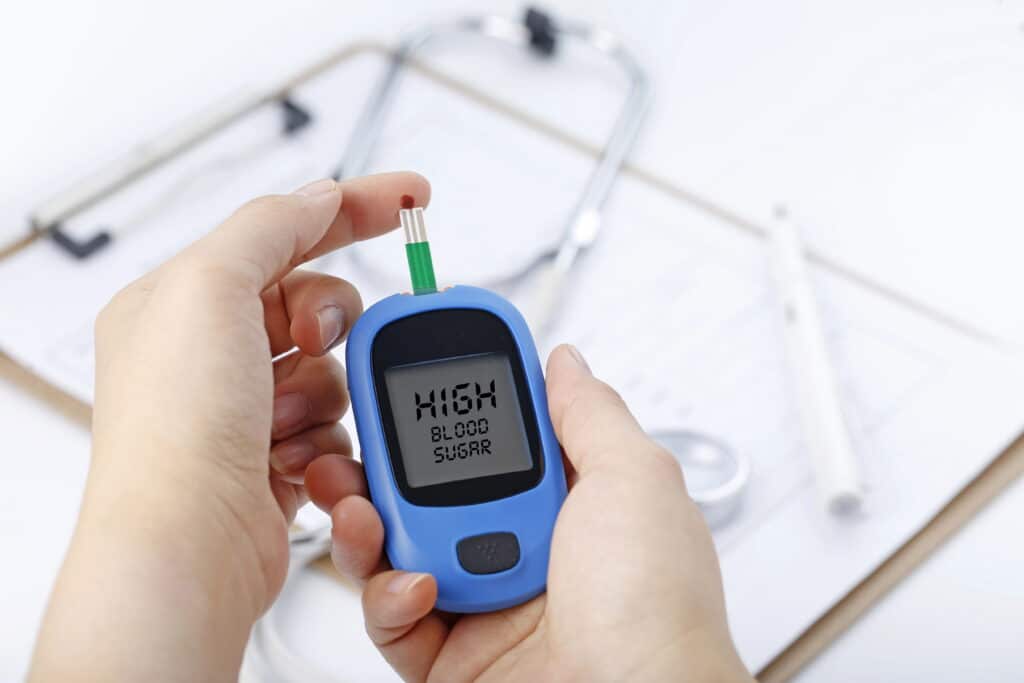
Unlike a finger-prick test, which offers one measurement at a particular moment, CGM shows direction and patterns. You can see whether glucose rises after a meal, how long it remains elevated and what happens after movement. This makes blood sugar monitoring feel less like collecting isolated numbers and more like observing a story.
There is a catch: CGM measures interstitial glucose, not blood glucose directly. Readings may lag behind rapid changes and can be affected by sensor pressure, placement or device-specific factors. A surprising result needs context; it does not prove that one food is “bad.”
What can a CGM reveal when you have prediabetes?
The greatest value of CGM for prediabetes may be its ability to make everyday habits visible. Used thoughtfully, a short trial can help answer practical questions such as:
- Does a sweetened coffee affect you differently from coffee taken with breakfast?
- Does adding protein, fibre or healthy fat change your response to a meal?
- What happens when you walk for 10 to 20 minutes after eating?
- Are late dinners followed by higher overnight readings?
- Do stressful days or short nights appear alongside different glucose patterns?
The goal is not to produce a perfectly flat line. Glucose normally rises and falls, including in people without diabetes. The useful question is whether the pattern helps you make a realistic choice. Someone might discover that a smaller portion of rice plus vegetables is satisfying and produces a gentler rise. Another person may find that a short walk after dinner is easier to sustain than a demanding exercise plan.
For some people, seeing the effect of a habit is more motivating than general advice.
Potential benefits of continuous glucose monitoring for prediabetes
It can support more personalised choices
People do not always respond identically to the same meal. Timing, portion size, activity, sleep and individual metabolism all matter. Continuous glucose monitoring for prediabetes may reveal patterns that a food diary alone misses.
It connects actions with results
HbA1c is valuable, but it changes slowly. CGM provides near-real-time feedback. That shorter loop may help a person test one sensible adjustment at a time instead of changing everything at once.
It gives your consultation more context
Paired with notes about meals, movement, sleep and symptoms, CGM data can make a conversation with an endocrinologist in Dubai more specific. The graph is most helpful alongside your history and laboratory results.
The limitations are just as important
CGM use in people with prediabetes is still an evolving area. Evidence that it improves long-term outcomes in this group remains limited, so it should not be presented as essential care or a guaranteed way to prevent type 2 diabetes.
Devices and sensors can be expensive, and coverage varies. If a short trial changes no decision, continuing may offer little value.
Some people feel informed by frequent readings; others become anxious or restrict nutritious foods because of a single spike. Chasing a “perfect” graph can distract from sustainable eating, movement, sleep and a healthy weight where appropriate.
Finally, the numbers need context. A CGM can show what happened, but it cannot always explain why. It does not replace HbA1c, fasting glucose or an oral glucose tolerance test, and it should not be used to start, stop or change medication without medical advice.
Who may find a short CGM trial worthwhile?
A clinician-guided trial may be useful if you have confirmed prediabetes and a clear question. Perhaps your HbA1c is rising despite changes, or you want structured feedback while building new habits.
It may not be worthwhile if the cost causes strain, the data is likely to increase anxiety, or you already have a clear and sustainable plan. Traditional blood sugar monitoring may be more appropriate in some situations, while others may not need home monitoring at all. The right choice depends on your risk profile and treatment goals.
Before buying a sensor, consider three questions:
- What specific behaviour or pattern am I trying to understand?
- Who will help me interpret unusual or conflicting readings?
- What action will I take based on what I learn?
If those answers are unclear, begin with a medical review instead of a device.
How to use a CGM without becoming ruled by the numbers
Agree on a limited trial period and a simple plan. Record meals, activity, sleep and unusual stress, but do not try to document every detail. Choose two or three repeatable experiments—for example, taking a walk after lunch or replacing a sugary drink—and compare patterns across several days.
Avoid judging a meal from one peak. Look for repeatable trends, and discuss them with a qualified clinician. Continue with recommended laboratory follow-up even when the CGM readings look reassuring.
Most importantly, use the device to build habits that can continue after the sensor comes off. The sensor is temporary; the routine is the real intervention.
Building a broader prediabetes plan
CGM is only one possible part of care. Research-backed prevention still centres on consistent physical activity, balanced eating and modest weight loss when medically appropriate. Losing about 5% to 7% of body weight can meaningfully reduce risk for many people with overweight, but targets should always be individualised.
At German Medical Center, patients can discuss metabolic risk through the Endocrinology Clinic, explore dedicated diabetes care, or arrange broader assessment through the Internal Medicine Clinic. GMC’s Internal Medicine Packages include glucose testing options, while the Gold package lists HbA1c. Your clinician can advise what suits you.
So, is a CGM worth using for prediabetes?
For the right person, a short, purposeful trial can be worthwhile. Continuous glucose monitoring for prediabetes can reveal patterns, make lifestyle advice more tangible and support a more focused clinical discussion. It is less useful when it creates anxiety, produces data without a plan or is treated as a diagnostic shortcut.
Think of a CGM as a temporary window, not a permanent referee. The best result is not an impressive graph. It is a clearer understanding of your body and a few manageable habits that protect your health over time.
If you have been told that your glucose is higher than normal, book a consultation at German Medical Center. An endocrinologist or internal medicine specialist can confirm your results, review your wider health risks and help you decide whether a CGM trial belongs in your personalised prediabetes management plan.
This article is for general information and does not replace individual medical advice, diagnosis or treatment.