

Most people do not look forward to discussing a colonoscopy, especially when they feel well and everyday life is already busy. Yet that is why screening matters: colorectal polyps and early colorectal cancer may cause no symptoms.
A colonoscopy allows a doctor to examine the lining of the rectum and colon with a thin, flexible camera. If a suspicious polyp is found, it can often be removed during the same procedure and sent for laboratory analysis, interrupting the process that can lead to cancer.
If you are considering colonoscopy screening in Dubai, three questions usually come first: Do I need it? When should I start? And, if the first examination is normal, when should I repeat it? The answers depend on your age, personal health and family history.
When should average-risk adults in Dubai start screening?
Dubai’s Periodic Health Screening Guideline advises colorectal cancer screening for men and women aged 40 to 75. For people at average risk, the listed options include a faecal immunochemical test, or FIT, every two years or a colonoscopy every 10 years. Emirates Health Services also advises screening from age 40 and lists colonoscopy every 10 years.
This local starting age is earlier than the age of 45 used in several international guidelines. For colon cancer screening in Dubai, the UAE recommendation is the relevant starting point, but a clinician should still consider your health, previous tests, medicines and family history.
After age 75, the decision is usually based on overall health, life expectancy, earlier results and personal preferences. Someone never screened may face a different choice from a person with a recent normal colonoscopy.
Who may need a colonoscopy before age 40?
Age-based guidance is designed for people at average risk. You may need an earlier assessment, a different starting age or more frequent surveillance if you have:
- A parent, sibling or child who has had colorectal cancer or an advanced polyp, particularly at a younger age
- A personal history of colorectal polyps or colorectal cancer
- Inflammatory bowel disease affecting the colon, including ulcerative colitis or Crohn’s disease
- A known or suspected inherited condition such as Lynch syndrome or familial adenomatous polyposis
- Previous abdominal or pelvic radiation, depending on the reason and timing
For family history, find out which relative was affected, whether the diagnosis was cancer or a polyp, and the age at diagnosis. Some higher-risk groups start at age 40 or 10 years before the youngest family diagnosis, whichever comes first. Ask a gastroenterologist in Dubai to personalise this timing.
Symptoms are not screening
Screening is intended for people without warning symptoms. If you notice rectal bleeding, blood in or on the stool, an unexplained persistent change in bowel habits, ongoing abdominal pain, iron-deficiency anaemia or unexplained weight loss, do not wait until you reach the screening age. These symptoms often have non-cancerous causes, but the CDC advises medical assessment.
In that situation, a colonoscopy may be recommended as a diagnostic test rather than a routine screening test. The distinction matters because the urgency, insurance approval and clinical pathway may be different. Seek prompt medical care for heavy bleeding, black stools, fainting, severe abdominal pain or rapidly worsening symptoms.
How often should colonoscopy be repeated?
For an average-risk adult whose examination is complete, bowel cleansing is adequate and results are normal, the usual interval is 10 years. That does not mean every patient should automatically return in exactly a decade. The endoscopist’s report and, when tissue is removed, the pathology result determine the next step.
Follow-up may be sooner when:
- One or more polyps are found
- A polyp is large, numerous, difficult to remove or has higher-risk features under the microscope
- The bowel was not clean enough to inspect the lining reliably
- The examination could not be completed
- The patient has inflammatory bowel disease, a hereditary syndrome or a significant family history
- New symptoms develop after the procedure
Intervals after polyp removal can range from months to several years. For example, widely used surveillance guidance recommends 7 to 10 years after complete removal of one or two small, low-risk tubular adenomas, while certain larger, more numerous or higher-risk polyps may require a three-year interval or earlier review. These details are deliberately based on the actual findings; “a polyp” is not one uniform diagnosis.
Before leaving the clinic, ask for a written answer to one practical question: When is my next test due, and why? Keep the colonoscopy and pathology reports. They remain useful even if you change doctors or move countries.
Is a stool test a substitute for colonoscopy?
For many average-risk adults, FIT is a valid screening option. It looks for small amounts of blood in a stool sample and does not require sedation or bowel cleansing. The Dubai guideline lists FIT every two years as an alternative to colonoscopy every 10 years.
There is an important condition: a positive FIT is not a final diagnosis and should be followed by colonoscopy. A negative result also does not explain persistent symptoms. People at increased risk may be advised to have colonoscopy rather than rely on a stool-based programme. The right choice is the test you can complete safely and on schedule after an informed conversation with your doctor.
What to expect from colonoscopy preparation
Ask patients what they remember most and many will mention the preparation, not the procedure. Good colonoscopy preparation matters because the doctor needs a clear view of the bowel lining. Inadequate cleansing can hide a polyp and may mean repeating the examination sooner.
Your clinic will give you specific instructions about food, clear fluids and a prescribed bowel-cleansing medicine. Follow that schedule exactly rather than adapting a plan found online. Tell the clinical team in advance if you take blood thinners, diabetes medicines, iron tablets or weight-loss medicines; if you have kidney or heart disease; or if you may be pregnant. Do not stop a prescribed medicine unless the treating clinician tells you to do so.
The laxative causes frequent watery bowel movements, so stay near a toilet and keep to the permitted clear fluids to reduce dehydration. On the procedure day, the team will review your history, explain the benefits and risks, and ask for consent. Sedation is commonly offered to help you relax. If you receive it, arrange for a responsible adult to take you home and follow the clinic’s restrictions on driving, work and important decisions afterward.
Serious complications are uncommon, but colonoscopy is not risk-free. Bleeding, a tear in the bowel, a reaction to sedation or a missed lesion can occur. Your individual risk may be higher if a large polyp is removed or you have certain medical conditions. The endoscopy team should explain what warning signs require urgent attention after you go home.
Choosing where to have a colonoscopy in Dubai
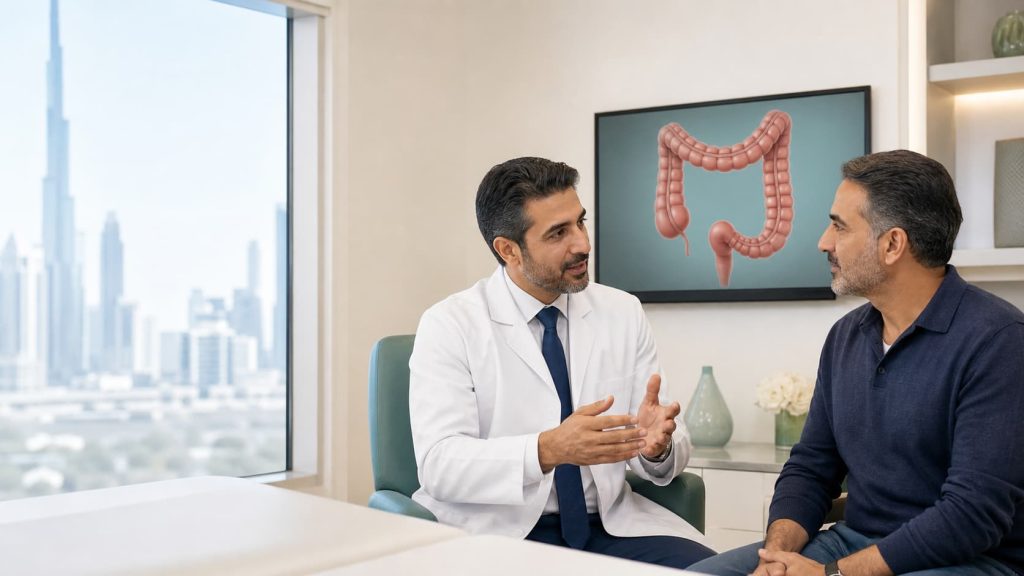
When arranging a colonoscopy in Dubai, look beyond the first available appointment. Ask who will perform the procedure, whether polyps can be removed during the same examination, where tissue samples are analysed, how results will be communicated and whom to contact if you feel unwell afterward. It is also sensible to check insurance approval and any separate charges before beginning preparation.
German Medical Center can connect this article to its Gastroenterology, Internal Medicine and General Surgery services. Gastroenterology is the natural next step for risk assessment, colonoscopy planning and digestive symptoms. Internal Medicine may help patients who need broader medical review or management of conditions and medicines before a procedure. General Surgery may become relevant if a finding needs surgical assessment. These links should guide readers to a clinically appropriate service, not imply that every patient needs all three.
The screening plan should fit the person
The simple version is worth remembering: for average-risk men and women in Dubai, colorectal screening begins at age 40, and a normal, high-quality colonoscopy is generally repeated every 10 years. The personal version is more important. Family history, symptoms, previous polyps, bowel disease and the quality of the examination can all change the timing.
If you are 40 or older and have not discussed screening, or if a close relative was diagnosed at a young age, book a consultation with German Medical Center. Bring any previous colonoscopy and pathology reports. A focused conversation now can replace uncertainty with a clear, written screening plan.
This article is for general education and does not replace individual medical advice. A clinician should confirm the appropriate screening test and interval for you.