


Medically reviewed by Prof. Gerald Zimmermann, Orthopaedics, German Medical Center.
Shockwave therapy may help some persistent tendon-related conditions, but the evidence differs by diagnosis. It should not be offered as a guaranteed cure for every painful heel, elbow or shoulder. Assessment and an appropriate rehabilitation programme come first; whether shockwave adds value depends on the condition, previous treatment and the uncertainties in the evidence.
What is shockwave therapy?
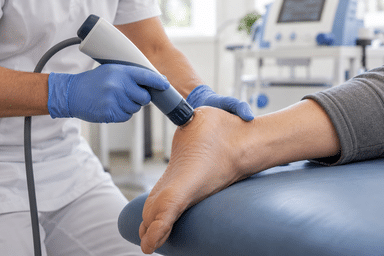
Extracorporeal shockwave therapy delivers mechanical pressure waves through a device applied to the skin. It is not an electrical shock. A clinician identifies the treatment area and applies an applicator, usually with contact gel. Sessions can be uncomfortable, and temporary soreness, redness or bruising may occur. Homerton Healthcare patient information
Treatment schedules and devices vary. Ask which type is proposed, how many sessions are planned and how the clinician will decide whether to continue. A package of sessions should have a clinical rationale, not simply a fixed sales format.
Heel pain: confirm plantar fasciitis first
Plantar fasciitis typically causes pain under the heel or arch, often worse on first steps after rest. Initial care can include adjusting load, appropriate footwear and stretching or exercise. Shockwave may be considered when symptoms persist despite earlier measures. NHS plantar fasciitis guide
Not every painful heel has the same cause. Describe the exact location, onset and activities that trigger symptoms. Mention injury, numbness or difficulty bearing weight so the clinician can decide whether another diagnosis or investigation needs attention before a treatment course.
Tennis elbow: why recommendations differ
Tennis elbow, also called lateral elbow tendinopathy, illustrates why claims need qualification. The British Elbow and Shoulder Society’s 2023 pathway recommends against shockwave for this condition. In contrast, a 2025 international expert-consensus study supports its use for selected tendinopathies, including common extensor tendon problems at the elbow. BESS pathway and international Delphi study
Expert agreement is not equivalent to strong trial evidence, and these differences should be explained openly. If shockwave is proposed for your elbow, ask why it is appropriate in your case, what alternatives remain and what degree of benefit is realistic.
Other tendon problems need their own evidence
Results from plantar heel pain cannot simply be transferred to Achilles, shoulder or patellar tendon pain. Even problems in different parts of the same tendon may respond differently. The international consensus paper identifies several potential applications but also discusses discrepancies between research findings and expert opinion.
A useful discussion names the diagnosis precisely. “Tendon pain” is too broad to judge a treatment claim. Ask whether the clinician is relying on controlled trials, professional guidance or their interpretation of limited evidence, and how that uncertainty affects the recommendation.
Who needs a safety review?
Tell the treating clinician about pregnancy, blood-thinning medication, bleeding problems, infection, recent injections or surgery, and other significant conditions. Suitability depends on the treatment site, device and clinical circumstances. These details should be reviewed before treatment, not after the first session. Homerton Healthcare guidance
Request written aftercare instructions, including activity advice and who to contact if symptoms worsen. Do not independently stop medicines to qualify for treatment.
Set a useful measure of success
Choose an activity that matters to you: comfortable first steps in the morning, lifting a kettle or returning to a particular exercise. Record how difficult it is before treatment and agree when it will be reassessed. A brief change immediately after a session is not the same as sustained improvement in everyday function.
Also clarify the exercise plan. If repeated sessions are proposed without a diagnosis, progress measure or rehabilitation discussion, ask for those gaps to be addressed before continuing.
Why diagnosis matters more than the machine
The treatment device does not determine the cause of pain. A clinician first needs to understand the location, pattern and history of the problem. A painful tendon after a sudden injury is a different situation from a long-standing load-related problem, and a symptom described as heel pain may have several possible explanations.
Bring a clear account of what provokes symptoms and what you can no longer do. Explain whether pain began suddenly or gradually, whether there was an injury and which treatments have already been tried. If imaging exists, bring the report and ask whether the actual images are needed. Avoid requesting a course of shockwave before the assessment has established a reasonable indication.
A useful first appointment should explain the working diagnosis and the role proposed for the treatment. If that role is an adjunct to rehabilitation, ask what the rehabilitation plan includes. You should understand how the session fits into care rather than viewing the machine as a stand-alone answer to a broad symptom.
Focused shockwave and radial pressure waves are not identical
The terminology used in clinics can be inconsistent. Focused shockwaves and radial pressure-wave treatments differ in how energy is generated and delivered. The international consensus study highlights variation in terminology and treatment protocols, which makes comparisons between studies and services more difficult.
For a patient, the important question is not which label sounds more powerful. Ask which method is proposed for your condition and why. A result from research using a particular device and protocol may not transfer directly to a different setup. The clinician should be able to explain the relevance without expecting you to interpret technical energy settings.
Also ask who will deliver the treatment and how changes in the plan are decided. If the person providing sessions differs from the clinician who assessed you, clarify how concerns and progress will be communicated. Consistent review is more useful than repeatedly receiving the same session without checking whether the original diagnosis and goals still fit.
Understand what “persistent” symptoms mean in practice
When a treatment is considered after earlier care has not helped, review what that earlier care actually involved. A few exercises tried intermittently, an unsuitable programme and a completed individual rehabilitation plan are not equivalent experiences. The purpose is not to blame the patient; it is to understand what has and has not been tested.
Explain barriers such as pain, work schedules, lack of equipment or uncertainty about technique. A clinician may be able to adjust the plan before adding another intervention. If shockwave is still proposed, ask what additional benefit is expected beyond those changes and how it will be measured.
Keep the review focused on function. A treatment history that records only names and dates can miss whether you became more able to walk, lift or exercise. Describe both the response and its duration. This helps the clinician distinguish a short-lived sensation of improvement from a meaningful change in the problem that brought you to care.
Heel pain: connect treatment with daily loading
If plantar fasciitis is the working diagnosis, explain the demands placed on your feet: standing at work, running, walking between buildings, footwear and changes in activity. The NHS guide describes supportive footwear, activity adjustment and exercise as parts of initial care. Shockwave is considered in the context of that wider plan.
Ask what activities you should continue, modify or temporarily avoid. Do not assume that all exercise must stop or that pain should always be pushed through. The appropriate plan should be explained in relation to your symptoms and clinical assessment.
Choose a specific marker such as the first walk after getting out of bed or the amount of standing you can manage at work. Record it consistently without repeatedly testing the area throughout the day. At review, ask whether the pattern suggests progress, a need to adjust load or a reason to reconsider the diagnosis.
Elbow pain: distinguish a recommendation from certainty
The disagreement in guidance for tennis elbow is important because it shows that a treatment can be offered in practice while evidence remains contested. The BESS pathway’s recommendation against shockwave should be part of an honest conversation, not omitted because a clinic uses the treatment. BESS pathway
If treatment is proposed despite that uncertainty, ask how the clinician weighs the evidence and what makes your case suitable. Discuss alternatives and whether further rehabilitation changes are reasonable. The explanation should identify uncertainty rather than presenting professional disagreement as proof that any claim is equally valid.
You can decide that a possible benefit is not worth the cost or inconvenience, or you may consider a carefully discussed trial appropriate. Either way, agree on the review point and criteria for stopping. A trial should not become an open-ended series simply because the next session has already been booked.
What happens during a treatment course?
Ask the provider to explain the session process before starting: how the area is identified, what sensations are expected, how discomfort is managed and when you should ask to pause. Consent is an ongoing conversation. You should be able to report discomfort or a concern without feeling that tolerating more intensity proves commitment.
Schedules vary, so clarify the proposed number and spacing of sessions and the reason for that plan. Ask whether the course may change depending on response. If a package is sold in advance, understand the cancellation or review arrangements before paying, particularly if the diagnosis or suitability is still being assessed.
After each session, follow the provider’s written activity and aftercare advice. Do not independently change medication to fit an online protocol. If advice seems inconsistent between clinicians, ask them to clarify which instructions apply to your circumstances and document the agreed plan.
What should be checked before treatment?
A safety discussion should include your medical history, medicines and any recent treatment in the area. Tell the clinician about conditions that might affect bleeding, healing or sensation, and mention pregnancy or possible pregnancy. The purpose is to assess suitability, not to use a generic checklist as an automatic approval.
Ask whether the device or treatment location creates specific restrictions. If you have had an injection or surgery recently, provide the date and details. “A treatment a few weeks ago” may not be enough for the clinician to judge how the plans interact.
If you are uncertain about a medicine, show the prescription or packaging. Do not stop a blood thinner or another important treatment on your own. The clinician responsible for prescribing it may need to be involved in any proposed change.
How to judge claims of success
A clinic may describe success using pain scores, patient satisfaction, return to sport or another outcome. Ask what the word means and over what time period it was measured. A short-term improvement in pain is not the same as a sustained return to a demanding activity.
Also ask whether the claim comes from published research, the provider’s own records or selected testimonials. Each has different limitations. If a percentage is quoted, ask which patients were included and whether those who did not finish treatment were counted. You do not need to perform a statistical analysis to ask for this context.
The most relevant outcome is one connected to your goals. A realistic discussion might focus on whether the treatment could help you progress with rehabilitation, rather than claiming that it repairs every damaged tendon. Keep expectations specific enough that a follow-up can determine whether the treatment was worthwhile.
Plan what happens if it does not help
Before starting, ask what would lead to stopping, changing the programme or seeking another assessment. This prevents uncertainty at the end of a course. A lack of improvement may prompt a review of the diagnosis, load management, exercise plan or other options rather than automatically repeating treatment.
Bring the same functional measures to follow-up that you agreed at the start. Explain any changes in work or exercise that could affect the comparison. If symptoms improved while activity was greatly reduced, discuss what happens as normal demands resume rather than assuming the problem has been permanently resolved.
A useful plan leaves you knowing the next step whether treatment helps or not. Shockwave can be part of a considered discussion, but it should not replace diagnosis, rehabilitation or a clear explanation of the evidence.
Check the proposed package before committing
If treatment is offered as a package, ask whether the number of sessions is a fixed commercial offer or a clinical plan that can change after reassessment. Confirm what happens if the diagnosis is reconsidered, treatment is poorly tolerated or the expected response does not occur. These details should be clear before payment.
Ask whether the quoted cost includes the initial assessment, rehabilitation advice and a review after the course. A series of machine appointments and a complete rehabilitation plan are not necessarily the same service. Understanding the difference helps you compare proposals fairly.
Keep the written plan and note the goals agreed at the start. At review, use those goals to discuss benefit rather than assuming that completing the purchased sessions proves the treatment succeeded. If further sessions are recommended, ask what new information supports continuing and what would trigger a different approach.
You can also request a summary for your usual clinician or physiotherapist. This helps ensure that changes to exercise or activity are understood by everyone involved in your care.
Discuss rehabilitation at German Medical Center
GMC’s physiotherapy service and orthopaedic department are possible starting points for assessment. Contact GMC to ask about the appropriate clinician and current treatment availability.
GMC also treats tennis elbow and Achilles tendon injuries. Related reading: plantar fasciitis and warning signs of an Achilles tendon injury.
This article explains general treatment considerations and does not establish your suitability for shockwave therapy.