


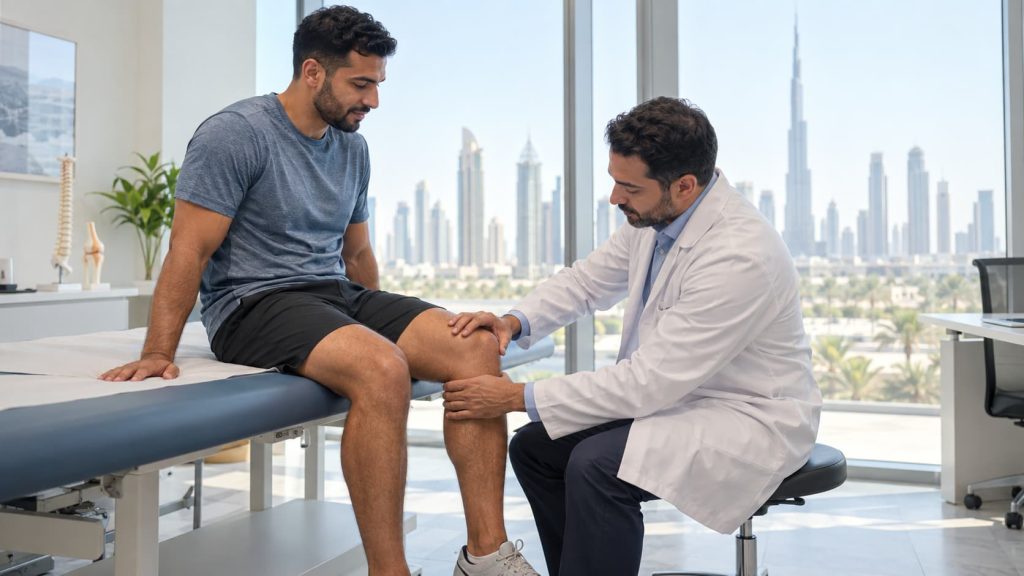
Dubai makes it easy to stay active. A padel match, an early run, football after work, or a gym session can all become part of the routine. The difficult part is knowing what to do when a sore ankle, swollen knee, or painful shoulder interrupts it. Does it need a few quiet days, or is it time to see a doctor?
Quick answer
Consider seeing a sports medicine or orthopedic doctor when pain is severe, follows a fall or collision, limits walking or normal movement, or comes with rapid swelling, instability, numbness, or a visible change in shape. An assessment is also sensible when a milder problem keeps returning or does not begin to settle with appropriate self-care. Suspected head injuries and obvious fractures require urgent medical attention.
Key takeaways
- Seek urgent care if a limb looks deformed, feels numb or cold, or cannot take weight.
- A sports medicine doctor often manages activity-related injuries, return-to-sport planning, and non-surgical care.
- An orthopedic doctor assesses bones, joints, ligaments, tendons, and muscles and can discuss both non-surgical and surgical options when relevant.
- Ongoing pain, repeated swelling, weakness, or a joint that gives way deserves assessment.
- Physiotherapy may form part of recovery, but the right starting point depends on the injury and its severity.
Not every sports injury looks dramatic
Some sports injuries in Dubai happen in a single, memorable moment: a knee twists during football, an ankle rolls on a kerb, or a shoulder takes the force of a fall. Others arrive gradually. A runner notices heel pain at the start of every session. A tennis player develops a stubborn ache around the elbow. A gym-goer can lift normally but feels shoulder pain when reaching overhead.
Acute injuries usually follow one event and can include sprains, strains, dislocations, fractures, or ligament tears. Overuse injuries build when repeated loading exceeds the body’s ability to recover. Tendon irritation and some forms of joint pain may start as a nuisance and become more limiting.
Pain alone does not reveal the diagnosis. Swelling, weakness, reduced movement, and the way the injury occurred add useful clues. An online checklist cannot replace a clinician’s examination.
When should you seek urgent medical attention?
Certain warning signs should move the decision beyond “wait and see.” Seek urgent medical care after a sports injury if:
- a bone or joint appears bent, displaced, or out of its normal shape;
- there is an open wound, heavy bleeding, or bone is visible;
- the injured area becomes numb, unusually pale or blue, or cold to the touch;
- you cannot take weight, walk a few steps, or use the limb normally;
- pain is intense or swelling develops quickly after a twist, impact, or fall;
- you heard a crack and suspect a fracture; or
- there is worsening redness, warmth, fever, or another possible sign of infection.
A blow to the head needs separate caution. Confusion, repeated vomiting, a worsening headache, loss of consciousness, seizure, slurred speech, unusual behaviour, weakness, or poor coordination can require emergency assessment. An athlete with a possible concussion should stop playing and should not return to sport on the same day. When symptoms are severe or worsening, use Dubai’s emergency services or attend an emergency department rather than waiting for a routine clinic appointment.
Signs it is time to book a sports injury assessment
Many cases are not emergencies but still merit professional attention. Book an assessment when pain is getting worse, keeps returning each time you train, wakes you at night, or remains despite reducing the aggravating activity. The same applies when swelling repeatedly returns, the joint catches or locks, strength has clearly fallen, or a knee or ankle feels as if it may give way.
A “pop” at the moment of injury can matter, especially when followed by rapid swelling or instability. For example, an anterior cruciate ligament injury may involve a popping sensation, pain, swelling, restricted movement, or a knee that feels unstable. Those symptoms are not proof of an ACL tear, but they are a reason to arrange a prompt assessment. GMC’s ACL injury service provides more detail about evaluation and possible care pathways.
Persistent heel or lower-calf pain deserves attention when it changes the way you walk or run. Sudden pain, weakness when pushing off, or a snapping sensation may suggest an Achilles tendon problem. See GMC’s Achilles tendon injury service for further information.
Sports medicine doctor or orthopedic doctor: who should you see?
There is considerable overlap, so choosing the “wrong” door is less likely than many people think. The best choice depends on the type of injury, how severe it appears, and the expertise available within the clinic.
A sports medicine doctor in Dubai commonly evaluates injuries linked to exercise. Care may cover diagnosis, load management, rehabilitation, injury prevention, and a staged return to activity. It is relevant to recreationally active people as well as athletes.
An orthopedic doctor in Dubai focuses on bones, joints, ligaments, tendons, and muscles. Assessment is particularly relevant for a possible fracture, dislocation, significant ligament or tendon injury, recurrent instability, or a problem that may need a surgical opinion. Seeing an orthopedic surgeon does not mean surgery is inevitable. The plan may instead involve activity changes, medication, bracing, physiotherapy, or further imaging.
At German Medical Center, patients can start with the Orthopedics Department, which covers sports injuries as well as other bone, joint, and muscle concerns. The profile of Dr. Shaddy Futtiny also outlines GMC expertise in orthopedic sports medicine, trauma, fractures, and knee and shoulder procedures. These links can help readers understand the available scope; a consultation is still needed to decide what is appropriate for an individual injury.
Where does physiotherapy fit?
Physiotherapy for sports injuries in Dubai can be valuable after the injury has been assessed and a suitable plan has been agreed. Depending on the case, rehabilitation may work on range of motion, strength, balance, control, gradual loading, and confidence in sport-specific movement. It can also help identify training habits or movement patterns that may contribute to repeated symptoms.
However, rehabilitation should match the diagnosis. Starting aggressive exercises before ruling out a fracture, major tendon injury, or unstable joint may not be appropriate. When the problem is mild and clearly improving, a physiotherapist may be a reasonable first contact. When there was significant trauma, marked weakness, instability, or uncertainty about the diagnosis, a medical assessment may be the better first step. GMC’s Physiotherapy Department includes injury assessment, rehabilitation, manual therapy, and exercise-based care.
What happens at the first appointment?
A sports injury doctor will begin with the story of the problem. Explain what you were doing, whether it was sudden or gradual, and what makes the pain better or worse. Mention any pop, rapid swelling, locking, giving way, numbness, or previous injury. Your sport, recent changes in workload, and return-to-activity goal also provide context.
The clinician may examine tenderness, swelling, movement, strength, and stability. Imaging is not required for every injury. An X-ray, ultrasound, MRI, or another test may be considered when it could change the diagnosis or plan.
Treatment is individual. A mild strain and an unstable knee should not share the same timetable. Care may involve changing activity, rehabilitation, support, medication when suitable, or a specialist procedure. Return to sport is usually based on function and the injury, not simply time passed.
What can you do while waiting for an appointment?
For a mild sprain or strain without warning signs, protect the area and pause the activity that caused pain. A wrapped cold pack may be used briefly. Compression and elevation may help with swelling, provided neither causes pain, numbness, or colour change. Avoid repeatedly testing the injury through painful drills.
Pain medicine is not suitable for everyone, particularly people with certain medical conditions or medicines, so ask a pharmacist or doctor if you are unsure. More importantly, do not use pain relief to mask symptoms and play through an injury. When normal movement can resume comfortably, a gradual return is generally more sensible than jumping straight back into full training.
A practical decision for active people in Dubai
The question is not whether an injury looks impressive; it is whether function is affected, symptoms are improving, and serious damage has been reasonably excluded. If you cannot use the area normally, symptoms are escalating, or the same problem keeps returning, an assessment can provide clarity. A sports medicine or orthopedic doctor can help define the injury, explain reasonable options, and coordinate sports injury treatment in Dubai with physiotherapy when appropriate.
German Medical Center offers orthopedic and physiotherapy services in Dubai Healthcare City. Readers who are unsure where to begin can review the linked departments and book an assessment with the most relevant clinician. This article provides general information and is not a diagnosis or a substitute for urgent or personalised medical care.